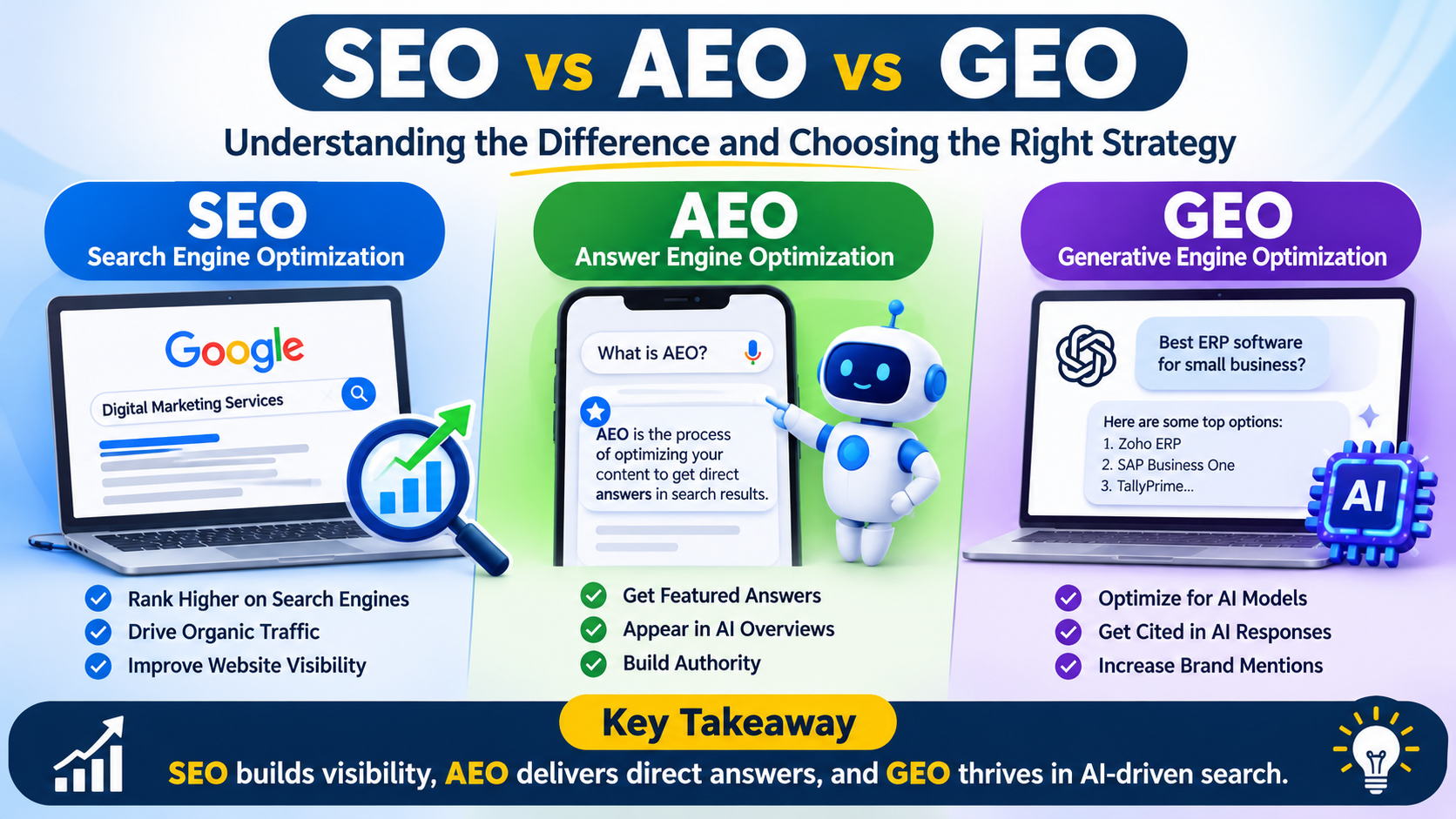
The digital marketing landscape is changing rapidly as people discover information through traditional search engines, AI-powered answer platforms, and generative search tools. Businesses can no longer depend on one marketing strategy to reach their audiences. They need to understand how different search approaches work and how each contributes to online visibility. SEO vs AEO vs GEO is an important topic for businesses, marketers, bloggers, and website owners who want to improve their digital presence.
Traditional search engine optimization focuses on improving website rankings, while answer engine optimization helps content appear in direct answers provided by search platforms. Generative engine optimization takes this approach further by making information easier for artificial intelligence systems to understand, reference, and present. Although these strategies have different purposes, they share one important goal: helping users find accurate and useful information.
What Is SEO and Why Does It Matter?
Search Engine Optimization (SEO) is the process of improving a website so that it appears higher in search engine results. It involves optimizing website content, technical performance, page structure, keywords, and backlinks to attract relevant organic traffic.
When someone searches for a product, service, or question on Google, search engines evaluate multiple factors before displaying results. Websites with relevant information, strong technical foundations, and useful content have better opportunities to rank.
Some important SEO practices include:
- Conducting keyword research to understand search demand.
- Creating informative and original website content.
- Optimizing title tags, meta descriptions, and headings.
- Improving website loading speed and mobile usability.
- Building relevant and trustworthy backlinks.
- Maintaining a clear internal linking structure.
SEO remains important because people still use traditional search engines to research products, compare services, and discover businesses. A well-optimized website can attract visitors consistently and help establish long-term online credibility.
SEO vs AEO: Understanding the Main Differences
The biggest difference between these two strategies is how information reaches the audience. SEO primarily focuses on improving a website's position in search engine results, whereas AEO focuses on making content suitable for direct answers.
For example, when someone searches for "What is inventory management software?" a traditional search engine may display several website links. An answer-focused platform may provide a summarized explanation directly on the results page.
SEO aims to bring users to a website, while AEO also focuses on making information accessible without requiring users to visit multiple pages.
Here are some important differences:
- Main objective: SEO focuses on organic rankings, while AEO focuses on answer visibility.
- Content structure: SEO uses optimized pages, while AEO benefits from clear questions and concise answers.
- Search experience: SEO supports traditional search journeys, whereas AEO supports direct information discovery.
- Visibility: SEO targets search engine results, while AEO aims to appear in featured snippets, voice responses, and answer-based search experiences.
Both approaches are valuable. Businesses that combine them can reach audiences through traditional search results and answer-driven experiences.
What Is Answer Engine Optimization?
Answer Engine Optimization (AEO) is the process of creating and organizing website content so that search engines and answer platforms can easily identify useful information and provide direct responses to user questions.
People increasingly search using complete questions instead of short keywords. They may ask, "Which ERP software is suitable for a manufacturing company?" or "How can small businesses manage their inventory?" AEO helps businesses create content that addresses these specific questions.
Some effective AEO techniques include:
- Adding clear question-based headings.
- Providing direct answers near the beginning of relevant sections.
- Using FAQ sections to address common customer concerns.
- Organizing information with bullet points and numbered steps.
- Implementing relevant structured data where appropriate.
- Publishing accurate, well-researched, and regularly updated content.
AEO is particularly useful for businesses that want to improve their chances of appearing in answer-focused search experiences. However, appearing in a direct answer is never guaranteed because search platforms decide which information to display.
AEO vs GEO: How Answer Engines and Generative Engines Differ
Although Answer Engine Optimization and Generative Engine Optimization are closely connected, they focus on different aspects of information discovery.
AEO focuses on helping platforms identify content that directly answers a user's question. GEO focuses on making information useful, understandable, and reference-worthy for generative AI systems that create responses using information from different sources.
For example, a user might ask an answer engine for the definition of digital marketing. AEO-friendly content provides a clear and direct explanation. On the other hand, someone using an AI assistant might request a detailed comparison of different digital marketing strategies. GEO-friendly content can help ensure that relevant information is understandable and potentially useful within a generated response.
Important GEO practices include:
- Publishing original research and meaningful insights.
- Supporting important claims with reliable sources.
- Providing detailed explanations of industry-related topics.
- Using clear headings and logically organized information.
- Maintaining consistent business information across trusted platforms.
- Demonstrating expertise through useful and accurate content.
The main idea is to make content valuable not only to human readers but also to AI systems that interpret and summarize information.
SEO vs GEO: Which Strategy Supports Better Online Visibility?
SEO and GEO both aim to improve online visibility, but they approach the objective differently. SEO concentrates on organic search performance, while GEO focuses on how generative AI platforms discover, interpret, and potentially reference information.
For example, an online software company may use SEO to rank its product pages for relevant search terms. At the same time, it can use GEO techniques by publishing detailed software comparisons, practical guides, original research, and expert explanations.
SEO performance is commonly evaluated through organic rankings, website traffic, click-through rates, and conversions. GEO is more concerned with visibility within AI-generated responses, brand mentions, and references from generative search experiences.
Neither strategy should completely replace the other. SEO provides a strong foundation for website discoverability, while GEO prepares content for the growing role of AI-assisted information discovery.
Businesses should focus on creating useful content that serves both traditional search users and people who rely on AI-generated answers.
Search Engine Optimization vs Answer Engine Optimization: Content Strategies That Work
Content plays an important role in both approaches, but the way information is presented can differ.
Traditional search optimization often requires comprehensive articles that target specific keywords and cover a subject in detail. Answer-focused optimization requires information to be organized so that platforms can quickly understand the question and identify a relevant response.
For example, a blog discussing cloud-based business software can target a primary keyword through its title, introduction, headings, and supporting paragraphs. It can also include a question such as "What are the benefits of cloud-based business software?" followed by a direct and informative answer.
To strengthen both strategies, businesses should:
- Research what their target audience is searching for.
- Create detailed articles that address genuine user requirements.
- Include relevant keywords naturally without unnecessary repetition.
- Add question-based headings and concise explanations.
- Use examples to make complex information easier to understand.
- Update outdated information to maintain content accuracy.
A balanced content strategy makes website pages useful for different types of search experiences while maintaining a natural reading style.
Answer Engine Optimization vs Generative Engine Optimization: Which One Should Businesses Choose?
Businesses often wonder whether they should prioritize AEO or GEO. The answer depends on their audience, industry, content objectives, and the platforms they want to reach.
AEO is useful when customers frequently search for specific questions, definitions, instructions, and quick solutions. For instance, an educational website can create direct answers to frequently asked questions to improve its chances of appearing in answer-focused search experiences.
GEO becomes particularly relevant when businesses want their expertise and information to be understandable and potentially referenced by generative AI platforms. Detailed industry guides, original reports, product comparisons, and expert-led articles can support this objective.
Instead of choosing only one, companies should build a combined strategy. They can create question-based content for AEO while developing detailed, authoritative resources for GEO.
This approach allows businesses to serve users who prefer quick answers as well as those who need detailed explanations before making decisions.
Generative Engine Optimization vs SEO: Preparing for the Future of Search
The growing use of artificial intelligence is changing how people interact with online information. Users increasingly expect search platforms to provide summarized answers, comparisons, recommendations, and explanations instead of simply presenting a list of websites.
SEO continues to provide the foundation for website visibility through search engines. GEO expands the content strategy by considering how generative systems interpret and use online information.
Businesses preparing for this change should focus on several important practices:
- Create original content that offers meaningful value.
- Publish detailed articles supported by trustworthy information.
- Maintain accurate author and business details.
- Develop topic-focused content instead of publishing unrelated articles.
- Use descriptive headings and structured formatting.
- Build brand credibility through genuine customer experiences and industry expertise.
It is important to understand that GEO does not guarantee AI citations or brand mentions. Generative platforms use different systems and sources to produce responses. However, providing reliable, relevant, and well-organized information gives content a stronger foundation for digital discoverability.
How Can Businesses Combine SEO, AEO, and GEO?
The most effective approach is to treat these three strategies as complementary parts of one digital marketing plan.
Businesses can start by building a technically sound website with valuable, keyword-focused content. Next, they can identify common customer questions and provide direct answers through FAQs, guides, and informative landing pages. Finally, they can strengthen their content with original research, detailed explanations, expert insights, and reliable references.
A practical combined strategy includes:
- Keyword research: Identify relevant search terms, customer questions, and informational topics.
- Content creation: Publish original articles that address different stages of the customer journey.
- Technical optimization: Improve website speed, mobile experience, indexing, and structured data.
- Answer optimization: Organize information into clear questions, direct answers, and helpful explanations.
- Authority building: Develop trustworthy resources that demonstrate real industry knowledge.
- Performance monitoring: Track organic traffic, rankings, conversions, and available AI visibility indicators.
Regular content updates are also important because customer expectations, industry information, and search technologies continue to evolve.
Conclusion
The way people discover information online is evolving, and businesses need to adapt their digital marketing strategies accordingly. SEO vs AEO vs GEO highlights the difference between improving traditional search visibility and making information accessible through direct answers. GEO adds another important dimension by focusing on how generative AI systems understand and potentially reference online content.
Rather than treating these approaches as competitors, businesses should use them together. SEO builds a strong foundation for organic discovery, AEO improves the presentation of direct information, and GEO helps prepare content for AI-driven search experiences.
A successful long-term strategy should prioritize useful content, technical quality, accuracy, and customer needs. Businesses that consistently deliver trustworthy information will be better prepared to respond to changing search behaviors and build a stronger digital presence.
Frequently Asked Questions (FAQs)
1. What is the main difference between SEO and AEO?
SEO focuses on improving website rankings in search engines, while AEO focuses on making content suitable for direct answers in search and answer platforms.
2. Is AEO replacing traditional SEO?
No. AEO complements SEO by supporting answer-based discovery. Traditional SEO remains important for website visibility, organic traffic, and long-term digital growth.
3. What does GEO mean in digital marketing?
GEO stands for Generative Engine Optimization. It involves creating clear, useful, and trustworthy content that generative AI platforms can understand and potentially reference.
4. Can businesses use SEO, AEO, and GEO together?
Yes. Businesses can combine keyword optimization, question-based content, structured information, and authoritative resources to support all three strategies.
5. Which strategy is best for improving online visibility?
There is no single best strategy for every business. Combining SEO, AEO, and GEO provides a broader approach to traditional search, direct answers, and AI-driven discovery.